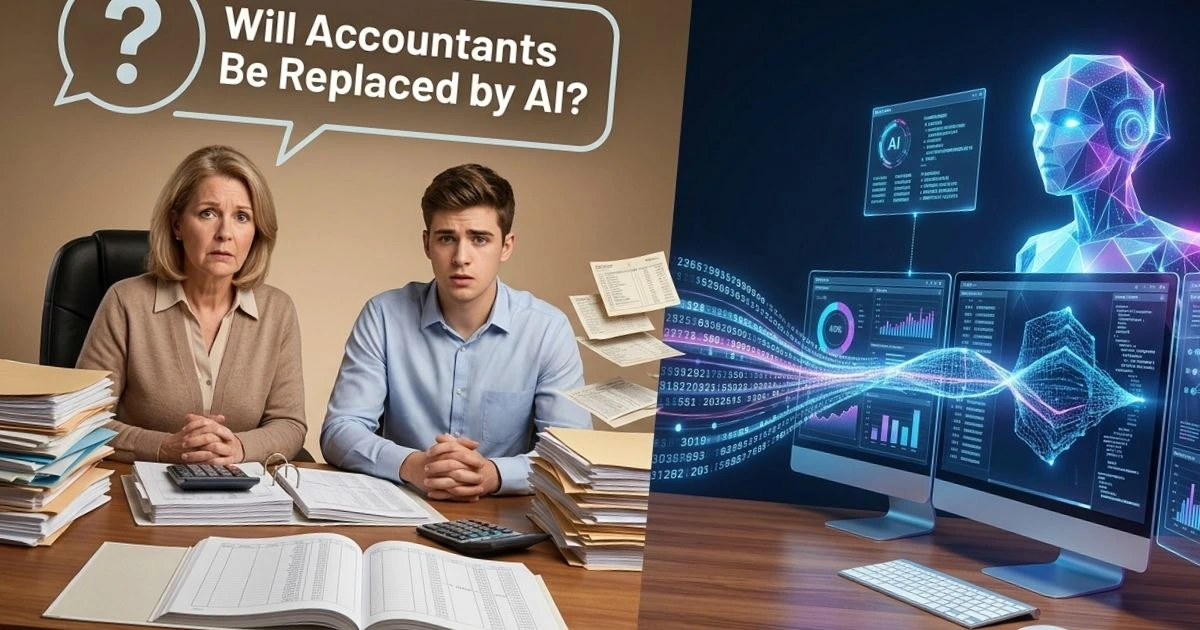
Will Accountants Be Replaced by AI? Future Career Guide
Table of Contents
You chose accounting because it made sense. Numbers follow rules. Debits equal credits. The logic is consistent, the demand is stable, and the career path is clear. But lately, something has been quietly unsettling that certainty. You’ve watched AI tools reconcile entire bank accounts in the time it takes to pour your morning coffee. You’ve heard colleagues mention clients who switched to automated bookkeeping platforms. And maybe — if you’re being honest with yourself — you’ve typed the question into a search bar late at night: will accountants be replaced by AI? This guide gives you the honest, evidence-based answer, along with a practical roadmap for wherever you are in your career.
The AI Revolution in Accounting — What’s Actually Happening Now
The transformation of accounting through AI isn’t a future event — it’s an ongoing present-tense reality that’s already reshaping the profession in measurable ways.
The Big 4 firms have made their positions clear through investment. PwC has committed $1 billion to AI tools and workforce upskilling. EY launched its EY.ai platform integrating AI across tax, audit, and advisory services. Deloitte’s Argus platform uses machine learning for continuous audit monitoring. These aren’t pilot programs — they’re full-scale deployments.
At the SMB level, platforms like Botkeeper, Pilot, and Bench are offering AI-powered bookkeeping as a subscription service, directly competing with traditional accounting firms for small business clients. The economics are compelling: faster turnaround, lower cost, 24/7 availability.
The ICAEW (Institute of Chartered Accountants in England and Wales) and AICPA have both published research indicating that more than 50% of current accounting tasks are susceptible to automation using existing technologies. That’s not a prediction — it’s a current-state assessment.
Will Accountants Be Replaced by AI? — Breaking Down the Evidence
The Case That AI Will Replace Accountants
The evidence on the displacement side is real and shouldn’t be minimized:
- McKinsey Global Institute estimates that approximately 85% of bookkeeping activities are automatable with existing technology
- AI platforms now process thousands of transactions in the time a human handles dozens
- The Big 4 are deploying AI audit tools that conduct continuous full-ledger monitoring — replacing the sample-based approach that justified large audit teams
- Rising AI accuracy in tax preparation is eroding the market for routine compliance work
The Case That Accountants Will NOT Be Replaced
The counterarguments are equally substantial — and historically better supported:
- Every previous wave of accounting technology (spreadsheets, accounting software, ERP systems) was predicted to reduce accountant demand. Each time, demand increased as complexity grew.
- Financial statements still require human professional sign-off under regulatory frameworks in virtually every jurisdiction
- Complex accounting work — M&A transactions, IPO preparation, international tax structuring — grows in complexity and demand as economies develop
- Businesses don’t just need accurate numbers; they need someone who can explain what those numbers mean and what to do about them. That’s a human skill.
The Real Impact — Transformation, Not Extinction
| Then (Pre-AI) | Now (AI Era) | Future (AI-Mature) |
|---|---|---|
| Manual data entry | Automated categorization | Fully autonomous bookkeeping |
| Sample-based audits | AI full-ledger scanning | Human oversight of exceptions |
| Annual tax preparation | Year-round AI monitoring | AI files; CPA reviews and signs |
| Monthly static reports | Real-time dashboards | Predictive advisory insights |
The pattern across every column is the same: the mechanical, procedural work shifts to AI; the interpretive, advisory, and judgment-based work remains with humans — and grows in value.
Career Paths for Accountants in the Age of AI
Pivot to Advisory and CFO-Track Roles
The most AI-resistant space in accounting is strategic advisory — helping business owners and executives understand what their financial data means and what decisions it should drive. CFOs who combine financial expertise with business acumen and communication skills will become more valuable as AI handles the underlying data work that previously consumed their teams’ time.
To advance in this direction, gain FP&A experience, pursue the CFA or CGMA designation, and actively seek client-facing roles that involve presenting and discussing financial insights instead of just preparing them.
Specialize in Emerging Accounting Fields
Some of the fastest-growing accounting niches are precisely those where AI has the least traction:
- Cryptocurrency and blockchain accounting — regulatory frameworks are still forming, complexity is high, and qualified professionals are scarce
- ESG (Environmental, Social, Governance) reporting — increasingly mandated by regulators worldwide, with evolving standards requiring interpretive professional judgment
- Forensic accounting — fraud investigation, litigation support, and expert witness testimony require skills that are genuinely irreplaceable
- International tax — cross-border transactions involve legal systems, treaties, and jurisdictional nuances that exceed current AI capability
Become an AI-Augmented Accountant
Perhaps the most practical near-term path is becoming the person in your firm or organization who knows how to work with AI tools more effectively than anyone else. Learn Botkeeper, Workiva, Sage Intacct, and the AI features within your existing platforms. Understand how to validate AI outputs, catch errors, and identify the edge cases where human judgment must override automated decisions.
The accountant who positions themselves as an “AI supervisor” — someone who understands both the accounting and the technology deeply enough to deploy and govern AI tools responsibly — will be extraordinarily valuable in the next decade.
Skills Accountants Need to Stay Relevant Against AI
| Skill | Why It Matters | How to Develop |
|---|---|---|
| Data Analytics | Interpret AI-generated outputs | Excel, Power BI, Tableau |
| Advisory Communication | Clients pay for insight and guidance | Client-facing project experience |
| AI Tool Proficiency | Efficiency multiplier in daily work | Vendor certifications and training |
| Strategic Finance | CFO-level thinking and business acumen | FP&A roles, CFA study |
| Ethics and Judgment | Regulatory requirement; irreplaceable | CPA ethics CPE, complex case experience |
What Top Accounting Firms Are Doing Right Now
The strategic direction of the major firms is instructive. PwC’s $1 billion AI commitment focuses equally on tool deployment and workforce training — they’re not replacing accountants, they’re retraining them. EY’s AI platform integrates across all service lines, with the explicit goal of freeing human professionals for higher-complexity advisory work.
Smaller regional firms are following suit at their scale, adopting Botkeeper and Pilot for SMB bookkeeping automation and refocusing human staff on the client advisory relationships that drive retention.
The direction is consistent: automate the routine, elevate the professional.
Advice for Accounting Students and Early-Career Professionals
If you’re studying accounting right now, the most important thing you can do is choose your path deliberately. The general-purpose bookkeeper or compliance accountant of 2024 faces genuine disruption. The forensic accountant, ESG reporting specialist, strategic CFO, or AI-literate accounting technologist of 2030 will be in higher demand than ever.
Build your technology skills from day one. Seek internships at firms that are investing in AI rather than hiding from it. Choose your CPA specialization with AI-resistance in mind. And develop the communication and advisory skills that no algorithm will replicate — because your ability to sit across a table from a business owner, understand their real problem, and explain what the numbers mean in plain language will always be worth more than any software subscription.
Conclusion
Will accountants be replaced by AI? The accountant who spends their career doing data entry and routine compliance work faces a genuinely difficult future. The accountant who moves up the value chain — toward advisory, specialization, and technology fluency — has a career ahead that is more interesting, more impactful, and more lucrative than any previous generation of the profession enjoyed. The profession is not ending. It’s being sorted. The question is simply which side of that sorting you choose to be on.
FAQ
Q: Will accountants be replaced by AI in the near future? Entry-level and routine accounting roles face significant automation pressure now and over the next five years. However, strategic, advisory, and specialized accounting roles are expected to grow in importance and demand.
Q: Are Big 4 accounting firms using AI to reduce headcount? The Big 4 are deploying AI extensively, but their public statements and investment strategies indicate a focus on redeploying staff toward higher-value advisory work rather than executing mass layoffs — at least in the current phase.
Q: What accounting specializations are safest from AI replacement? Forensic accounting, ESG reporting, international tax, cryptocurrency accounting, and CFO-level strategic advisory roles offer the strongest long-term protection from AI automation.
Q: Should accounting students worry about AI taking their jobs? Students who develop AI literacy alongside traditional accounting skills are uniquely positioned to lead the next generation of the profession. The risk belongs to those who develop only traditional skills and ignore the technology transformation underway.
Q: How are accountants using AI as a tool rather than being replaced by it? By learning to supervise and validate AI-generated outputs, focusing on interpretation and advisory rather than preparation, and building the client communication skills that drive relationships — the dimensions of accounting work where human connection remains irreplaceable.
Are you an accounting student or professional thinking about how AI is changing your career path? Share where you’re at in the comments — and if this guide helped clarify your thinking, share it with a colleague who’s asking the same question.