Will Accounting Be Replaced by AI in the Future?
Table of Contents
For generations, a career in accounting meant stability. It meant job security through recessions, industry disruptions, and economic cycles that wiped out other professions. The numbers always needed someone to manage them. But today, something different is happening. AI systems reconcile bank statements in milliseconds. Tax returns get filed autonomously. Fraud detection algorithms catch anomalies that human auditors would have missed entirely. If you’ve been asking yourself — genuinely, anxiously — “will accounting be replaced by AI?” — you deserve a serious, honest answer. Not reassurance. Not panic. The truth.
What AI Is Already Doing in Accounting
Before you can assess the future, you need to understand the present — and the present is already more automated than most people outside the profession realize.
Automated Bookkeeping
Platforms like QuickBooks AI, Xero, and Botkeeper have turned routine bookkeeping into a largely automated process. These tools categorize transactions, reconcile accounts, match invoices, and generate financial reports with minimal human input. Botkeeper, specifically, combines AI with human oversight to offer fully automated bookkeeping as a service — at a fraction of the cost of a traditional bookkeeper. For small and medium-sized businesses, the economic case for human bookkeepers doing data entry is becoming increasingly difficult to make.
Tax Preparation and Filing
Consumer tax preparation has been semi-automated for years, but the new generation of AI tools goes further. TurboTax’s AI features now auto-populate returns from uploaded documents, identify deduction opportunities the user didn’t know existed, and flag compliance issues — all in a conversational interface. For straightforward individual and small business returns, the gap between AI-assisted filing and professionally prepared returns has narrowed significantly.
Audit and Fraud Detection
This is perhaps the most significant development in accounting AI. Tools like MindBridge Ai Auditor don’t just sample transactions — they analyze entire general ledgers, scoring every single entry for anomaly risk. The Big 4 firms have invested hundreds of millions in proprietary AI audit tools: KPMG’s Clara, Deloitte’s Argus, and EY’s Helix all perform continuous transaction monitoring at a scale and speed no human audit team could approach.
Financial Forecasting and Reporting
Platforms like Anaplan, Workday Adaptive Planning, and Oracle EPM now automate much of the financial modeling and forecasting process that once required dedicated FP&A analysts. Boards receive real-time dashboards rather than monthly static reports. Scenario planning that once took analysts days to build now runs in minutes.
Will Accounting Be Replaced by AI? — Task-Level Analysis
| Accounting Task | AI Capability | Automation Risk | Timeline |
|---|---|---|---|
| Data entry / bookkeeping | Very High | Very High | Already happening |
| Tax prep (simple returns) | High | High | 2–5 years |
| Audit sampling | High | Medium | 3–7 years |
| Financial analysis | Medium | Medium | 5–10 years |
| Advisory / CFO functions | Low | Low | 10+ years |
| Stakeholder communication | Very Low | Very Low | Not foreseeable |
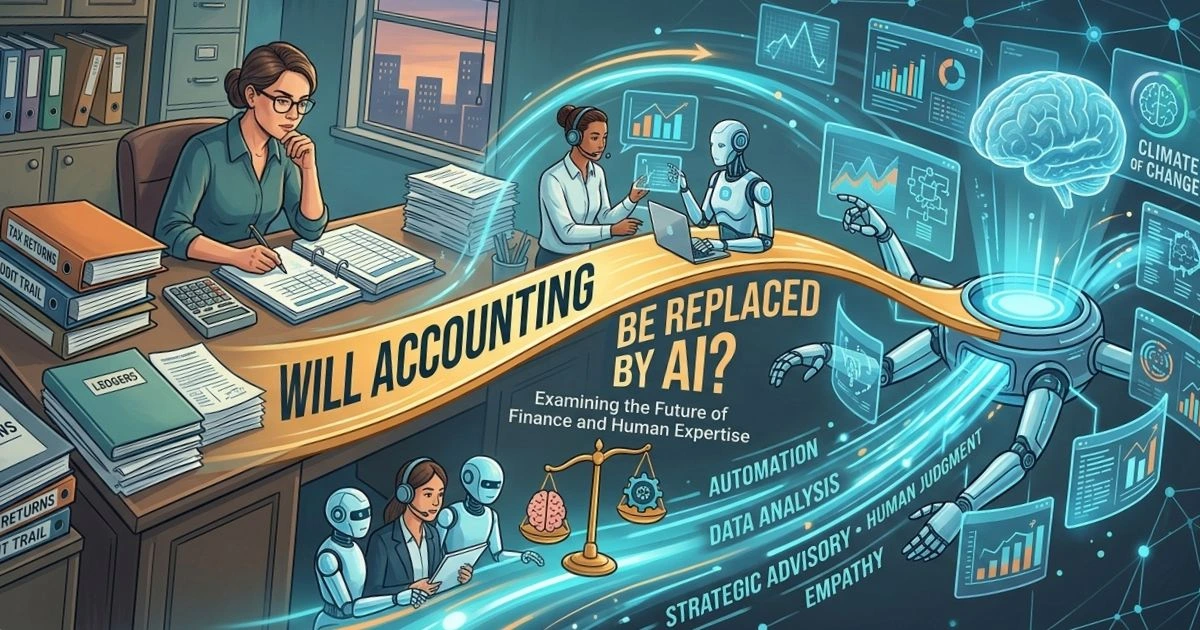
The table reveals a clear spectrum: the more a task resembles structured information processing, the more vulnerable it is. The more it requires judgment, interpretation, communication, and trust, the more it remains fundamentally human.
Which Accounting Roles Face the Highest Risk?
The roles most exposed to AI automation share a common characteristic: their primary value comes from processing information rather than interpreting it.
- Bookkeepers and data entry clerks — already being replaced at scale by AI-powered platforms
- Junior tax preparers — straightforward returns are increasingly handled without human preparation
- Accounts payable and receivable clerks — AI tools like Bill.com and Tipalti automate invoice processing and payment workflows
- Payroll administrators — platforms like Gusto and Rippling handle payroll with minimal human intervention
Which Accounting Roles Are AI-Resistant?
The roles with the strongest protection from AI replacement are defined by complexity, judgment, and human relationship:
- CFOs and financial strategists — translating financial data into business decisions requires contextual understanding AI cannot replicate
- Forensic accountants — fraud investigation requires legal judgment, interviewing skills, and courtroom testimony
- Complex tax advisors — high-net-worth, multi-jurisdictional, and estate planning work involves interpretive judgment that exceeds current AI capability
- Management accountants — serving as business partners to operational leaders requires communication and strategic thinking
- ESG and sustainability reporting specialists — a rapidly growing field with evolving standards where human expertise is in short supply
Historical Precedent — Has Technology Replaced Accountants Before?
This is the most important context most discussions of accounting and AI ignore: we have been here before.
When electronic spreadsheets arrived in 1979, experts predicted the end of accounting as a profession. When accounting software went mainstream in the 1990s, the same warnings echoed. In both cases, the result was not fewer accountants — it was more accountants doing more complex work, because technology lowered the cost of financial management enough that demand expanded dramatically.
The pattern suggests that accounting will not be eliminated by AI. It will be transformed, elevated, and in aggregate, expanded — though the specific tasks within it will shift radically.
How to Future-Proof an Accounting Career Against AI
The accountants who will thrive over the next decade are those who move proactively up the value chain:
- Learn the AI tools — QuickBooks AI, Xero, Botkeeper, and Workiva are becoming standard literacy
- Pursue high-value certifications — CPA, CFA, and CGMA credentials carry authority that AI tools cannot replicate
- Focus on emerging specialties—ESG reporting, cryptocurrency taxation, and M&A accounting—which are rapidly expanding fields currently facing shortages of qualified human experts.
- Develop advisory skills — communication, strategic thinking, and client relationship management are your most durable differentiators
- Understand what the AI produces — knowing how to validate, correct, and interpret AI-generated financial data will be a core professional competency
Conclusion
Will accounting be replaced by AI? Honestly — parts of it already are. Routine bookkeeping, simple tax preparation, and transaction-level audit work are being automated at a pace that should command serious attention from anyone in those roles. But the accounting profession as a whole is not dying. It’s undergoing the same transformation it has navigated through every previous wave of technology: the routine work disappears, the complex work grows, and the professionals who adapt find themselves doing more valuable work than ever before. The question isn’t whether accounting will survive AI — it’s whether you will position yourself on the right side of that shift.
FAQ
Q: Will accounting be replaced by AI in the next 10 years? Routine, transactional accounting tasks will see heavy automation over the next decade, but strategic advisory roles, complex tax work, and CFO-level functions will remain human-driven and are expected to grow in importance.
Q: What accounting jobs are most at risk from AI? Bookkeeping, data entry, simple tax preparation, and accounts payable/receivable processing face the highest automation risk and are already seeing significant disruption from AI-powered platforms.
Q: Should I still study accounting if AI is advancing? Yes — but focus your studies and career development on advisory, analytical, and technology-integrated skills. The accounting professionals with the strongest futures are those who can interpret and act on what AI produces, not just produce the numbers themselves.
Q: Which AI tools are already replacing accounting tasks? QuickBooks AI, Xero, Botkeeper, and MindBridge Ai Auditor are already automating bookkeeping, reconciliation, and audit sampling tasks across thousands of businesses globally.
Q: Will AI replace CPAs? CPAs focused on complex advisory, strategic planning, and judgment-intensive work are well-protected. Those primarily performing compliance-level work face more pressure as AI tools improve in those specific areas.
Are you an accounting professional navigating the AI transition? Share what changes you’re already seeing in your work — your perspective is exactly what other readers need to hear.