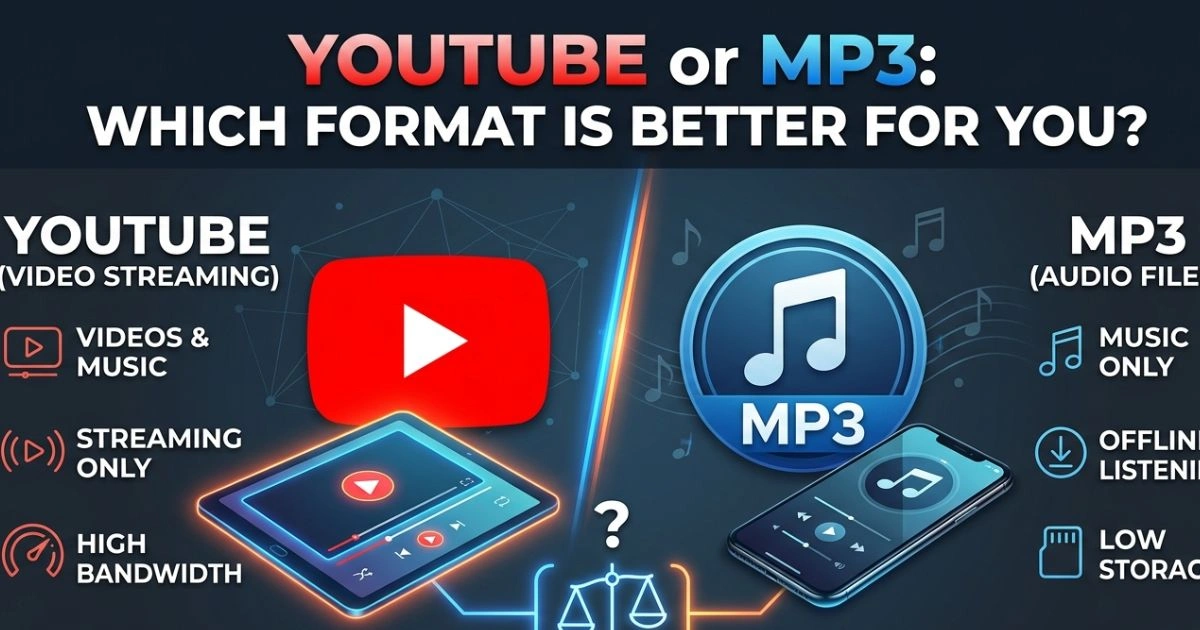
YouTube or MP3: Which Format Is Better for You?
Table of Contents
You’re sitting on a train, headphones in, ready to lose yourself in music for the next hour. You tap play — and nothing happens. No signal. Your YouTube playlist is completely useless. Meanwhile, the person next to you is already deep into their favorite album, stored right on their phone, no internet needed.
That moment of silence when you wanted music the most? That’s what this article is here to prevent.
Choosing between YouTube and MP3 isn’t just a technical decision — it’s a lifestyle one. It affects how you listen, where you listen, how much you spend, and even how much you truly own the music you love. Whether you’re a casual listener, a daily commuter, a fitness enthusiast, or someone who simply wants the best possible sound, the format you choose matters more than you might think.
By the time you finish reading this, you’ll know exactly which format fits your life — and why.
Understanding the Basics — What Are YouTube and MP3?
Before diving into the comparison, it helps to understand what you’re actually dealing with. These two formats are fundamentally different in how they work, and that difference shapes everything.
What Is YouTube?
YouTube is a video and audio streaming platform owned by Google, and with over 2.7 billion monthly active users as of 2024, it is the largest video platform on the planet. When you listen to music on YouTube, you’re not downloading anything — you’re streaming it in real time, which means data is pulled from remote servers directly to your device as you listen.
YouTube’s free tier gives you access to virtually endless content, but it comes with interruptions: ads, screen-off restrictions on mobile, and a complete dependence on your internet connection. YouTube Premium, priced at around $13.99 per month in the US, removes ads and adds offline download capability — but even those offline files are locked inside the YouTube app and expire if your subscription ends.
What Is MP3?
MP3 stands for MPEG Audio Layer III. It’s a compressed digital audio file format that has been around since 1993, and despite the rise of streaming, it remains the most widely used audio format in the world. When you have an MP3 file, it lives directly on your device. No internet needed. No subscription. No expiration date.
You can play it on your phone, your laptop, your old iPod, a USB drive in your car, or virtually any audio device ever made. It’s yours — fully and completely.
A Quick Comparison at a Glance
| Feature | YouTube | MP3 |
|---|---|---|
| Internet Required | Yes | No |
| Audio Quality | Up to 256 kbps AAC | Up to 320 kbps |
| Cost | Free / ~$13.99/mo Premium | Free after download |
| Storage Used | Streamed (no local storage) | Requires device storage |
| Offline Access | Premium only | Always available |
| Video Support | Yes | No |
| Ownership | None | Full |
Sound Quality — Which One Actually Sounds Better?
This is the question audiophiles care about most. And the answer might surprise you.
YouTube Audio Quality Explained
YouTube compresses audio using the AAC (Advanced Audio Coding) format, typically at bitrates between 126 kbps and 256 kbps, depending on the video quality selected. What this means practically is that the audio you hear has already been processed and compressed — sometimes multiple times if the original uploader also compressed their file before uploading.
Beyond that, your actual listening experience on YouTube is affected by your internet speed at any given moment. When your connection dips, YouTube automatically reduces streaming quality, which directly impacts the sound coming through your headphones. You might not notice it consciously, but your ears do.
MP3 Audio Quality Explained
MP3 files come in different bitrates — the most common being 128 kbps for standard quality and 320 kbps for high quality. At 320 kbps, an MP3 file delivers near-lossless audio that most people — including many experienced listeners — genuinely cannot distinguish from a CD-quality track.
Critically, an MP3 file sounds exactly the same every single time you play it. There’s no buffering degradation, no mid-song quality drop, no compression artifacts caused by a weak Wi-Fi signal. What you hear is consistent, reliable, and fully within your control.
For Audiophiles — Does the Difference Actually Matter?
For most casual listeners, the difference between a 256 kbps AAC stream on YouTube and a 320 kbps MP3 is nearly imperceptible — especially on standard earbuds or phone speakers. However, if you listen through quality headphones or a dedicated audio system, the gap becomes noticeable.
Studies and blind listening tests within audiophile communities consistently show that high-bitrate MP3 files outperform compressed streaming audio, particularly in the reproduction of high frequencies and dynamic range. If your ears matter to you, MP3 wins this round clearly.
Internet Access and Offline Use — The Factor That Changes Everything
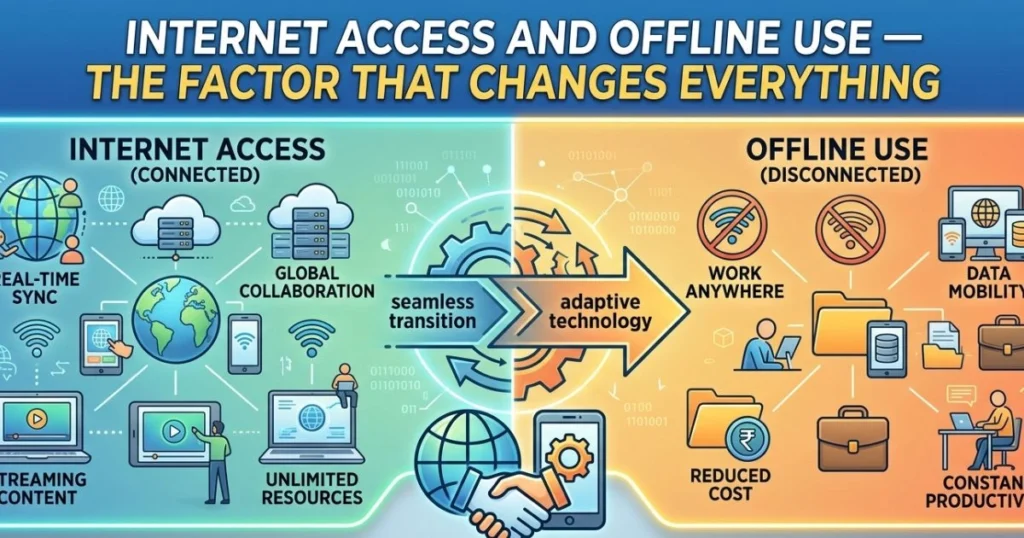
Here’s where the real-world gap between YouTube and MP3 becomes impossible to ignore.
When You Have No Internet
Your MP3 files don’t care whether you have internet or not. They’re stored on your device, and they play whenever you press play — on a plane at 35,000 feet, in a remote hiking area, on a subway deep underground, or in a country where data roaming costs a fortune.
YouTube, on the other hand, becomes completely silent the moment your connection disappears. Even with YouTube Premium’s offline downloads, those files are locked inside the YouTube app, tied to your subscription, and unavailable on any other platform or device.
Is YouTube Premium’s Offline Feature Worth It?
If you’re considering YouTube Premium specifically for offline music, it’s worth asking a hard question: are you paying $13.99 per month for something that MP3 gives you for free?
YouTube Premium does offer genuine value — ad-free browsing, background play, and YouTube Music access are all included. But the offline download feature has serious limitations. Your downloads expire when your subscription lapses, you can only play them inside the YouTube app, and you’re completely locked into Google’s ecosystem. The moment you stop paying, your library disappears.
Data Consumption — A Real Cost You Might Be Ignoring
| Usage Scenario | YouTube (HD Streaming) | MP3 Playback |
|---|---|---|
| 1 hour of music | 150–250 MB | 0 MB |
| 10 songs | 50–80 MB | Stored once, ~30–40 MB |
| Daily use (2 hrs) | ~300–500 MB | Near zero |
| Monthly total | 9–15 GB | Minimal |
If you’re on a limited data plan — and most people are — streaming YouTube music daily quietly drains your allowance. Those gigabytes add up fast, and they translate directly into money. MP3 costs you nothing after the initial download.
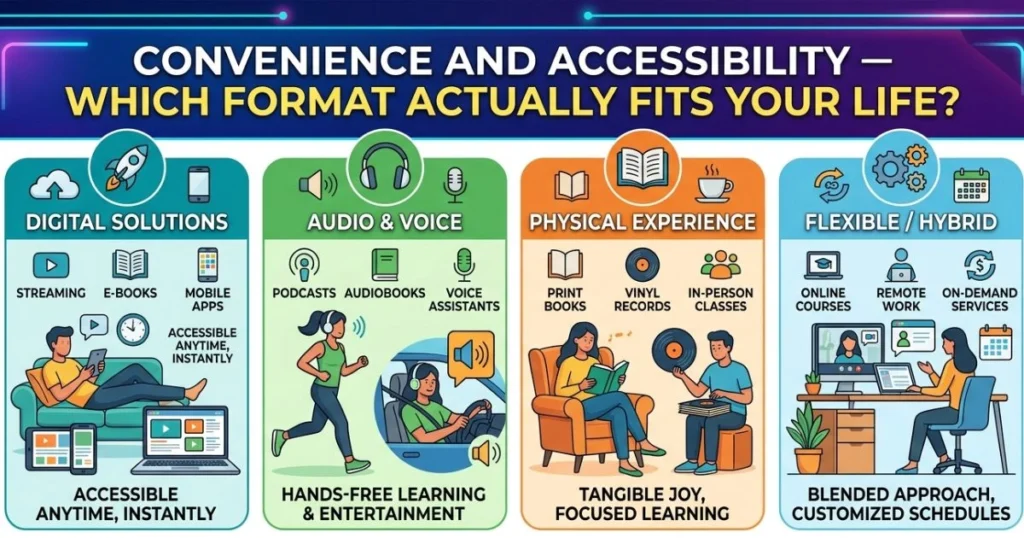
Convenience and Accessibility — Which Format Actually Fits Your Life?
YouTube — The All-in-One Entertainment Platform
There’s no question that YouTube offers something MP3 simply cannot: a complete visual and audio experience combined. You get official music videos, live concert recordings, lyric videos, acoustic sessions, remixes, covers, and an algorithm that actively introduces you to music you’ve never heard before.
YouTube is available on smart TVs, gaming consoles, browsers, phones, and tablets. For discovery, entertainment, and sheer variety, it’s genuinely unmatched. If you’re the kind of listener who loves watching an artist perform, reading lyrics as a song plays, or stumbling onto a new favorite band through a recommendation — YouTube is your natural home.
MP3 — Simplicity, Control, and True Ownership
MP3 gives you something streaming never fully can: complete ownership of your music. You don’t need an account, an app, or a subscription. Your files work on every device — including older ones that don’t support modern apps. You control your library, your folder structure, your playlist organization, and your listening experience without any algorithm deciding what you hear next.
For people who’ve spent years building a carefully curated music collection, that level of control is deeply satisfying. Your library is yours, permanently, regardless of what any platform decides to remove, license differently, or hide behind a paywall next year.
Who Should Choose Which Format?
- Casual home listener who loves discovering new music → YouTube is a natural fit
- Daily commuter or frequent traveler → MP3 is the clear winner
- Gym-goer who needs reliable playback mid-workout → MP3, no question
- Someone on a tight data plan → MP3 saves you money every month
- Music video lover or concert watcher → YouTube has no competition here
- Audiophile who demands consistent sound quality → MP3 at 320 kbps
Cost Comparison — Free vs. Free (But Not Really)
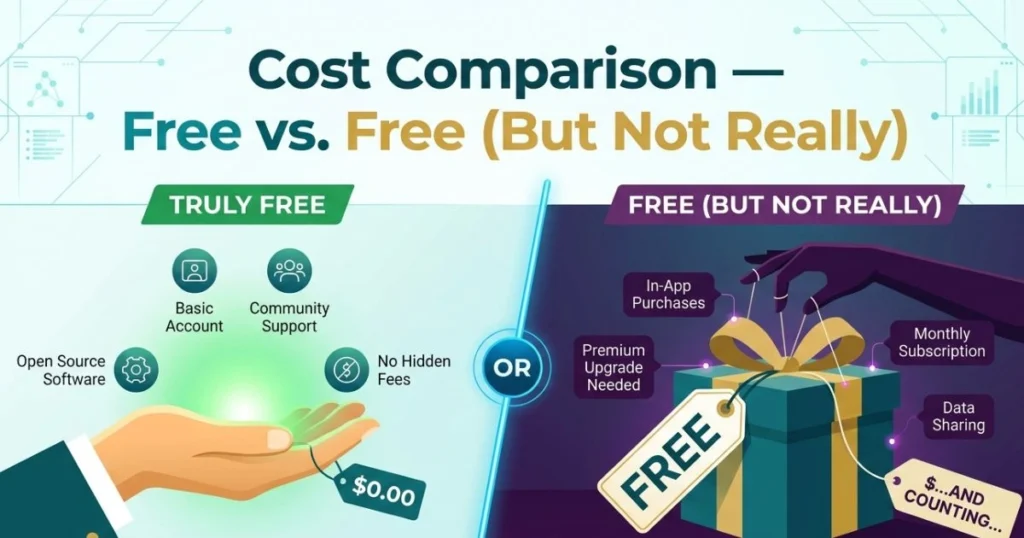
Both YouTube and MP3 can technically be accessed for free — but “free” doesn’t mean the same thing in both cases.
The Hidden Cost of “Free” YouTube
YouTube’s free tier is genuinely free, but it costs you in ways that don’t show up as a line item. You endure ads — sometimes multiple ads per song. On mobile, the screen has to stay on for music to keep playing, which kills your battery. Your data is constantly being consumed. And the moment you want any of that resolved, you’re looking at a monthly subscription.
Over five years, YouTube Premium at $13.99/month adds up to approximately $839. That’s a significant investment for content you never truly own and access that disappears the moment you stop paying.
The Real Cost of MP3
MP3 files can be sourced legally through platforms like Bandcamp, iTunes, Amazon Music, and others. Individual songs typically cost $0.99–$1.29, and full albums run $7–$12. A substantial personal music library of 500 songs might cost you $100–$200 total — a one-time investment that never expires, never requires renewal, and never gets taken away.
| Over 5 Years | YouTube Free | YouTube Premium | MP3 Library |
|---|---|---|---|
| Subscription Cost | $0 | ~$840 | $0 |
| Data Costs | High (ongoing) | High (ongoing) | Minimal |
| Music Ownership | None | None | Full |
| Total Real Cost | Medium-High | Very High | Low |
Legal and Ethical Considerations
This section matters more than most guides admit.
Is Converting YouTube to MP3 Legal?
Directly downloading or converting YouTube videos to MP3 files — using tools commonly marketed as “YouTube to MP3 converters” — violates YouTube’s Terms of Service. YouTube explicitly prohibits downloading content without prior authorization from the platform or the content creator.
Beyond the terms, there are also copyright implications. The music on YouTube is licensed to the platform, not to individual users for download. Converting a YouTube video to MP3 for personal use sits in a legal gray area in many countries, but distributing those files is clearly illegal.
If you want to legally own MP3 versions of your favorite music, the right path is through licensed platforms: Bandcamp, iTunes, Amazon Music, or directly from an artist’s official website.
Supporting Artists — Where Your Money Actually Goes
When you stream a song on YouTube for free, the artist earns a fraction of a cent — typically between $0.001 and $0.003 per stream. To earn the equivalent of one minimum-wage hour, an independent artist needs tens of thousands of streams.
When you buy an MP3 directly from Bandcamp, the artist receives approximately 80–85% of the purchase price. If supporting the musicians you love matters to you, buying MP3s is one of the most direct ways to do it.
Real-World Use Cases — When Each Format Wins
YouTube Is the Better Choice When…
- You’re relaxing at home with a reliable Wi-Fi connection
- You want to watch the official video alongside the music
- You’re in the mood to explore and discover new artists
- You’re using a smart TV or home entertainment system
- You want karaoke versions, covers, or live performances
- You’re sharing music socially or watching with others
MP3 Is the Better Choice When…
- You’re traveling and can’t guarantee a data connection
- You’re at the gym and need uninterrupted playback
- You’re in an area with poor or expensive internet access
- You want to preserve battery life (streaming drains it faster)
- You’ve built a personal collection you want to keep permanently
- You care about consistent, high-quality audio without variables
The Future — Is MP3 Going the Way of the CD?
The Rise of Streaming Culture
There’s no denying the direction things are moving. Spotify, YouTube Music, Apple Music, and Amazon Music collectively dominate how people listen today. Among Gen Z listeners, over 80% primarily use streaming services. The convenience and discovery features of streaming are genuinely powerful, and they’ve changed listening habits across an entire generation.
Why MP3 Still Holds Its Ground
Despite the streaming surge, MP3 is far from dead. Independent musicians still distribute their work as MP3 files. Podcasters use MP3 as the universal format for episodes. In parts of Africa, Southeast Asia, and South America where mobile data is expensive and inconsistent, offline audio files remain the primary way people listen to music.
Additionally, a growing backlash against subscription fatigue — the exhaustion of paying monthly for everything from music to TV to software — is pushing some listeners back toward ownership. When you own your MP3 files, no price increase, no platform shutdown, and no licensing dispute can take your music away.
What Comes After Both?
The formats that are genuinely challenging both YouTube and MP3 are lossless audio formats — FLAC and WAV — along with spatial audio technologies like Dolby Atmos, which Apple Music and Amazon Music HD now offer. These formats deliver audio quality that MP3 cannot match and streaming depth that YouTube doesn’t attempt.
If you’re already thinking beyond this comparison, high-resolution audio is your next frontier.
Conclusion — So, YouTube or MP3: Which One Is Right for You?
Here’s the honest answer: neither format is universally better. What matters is which one serves your specific listening habits, lifestyle, and priorities.
If your music life revolves around discovery, visual content, and home listening with a reliable internet connection, YouTube gives you a world-class, essentially unlimited music experience — especially with Premium. It’s dynamic, social, and endlessly varied.
If you value reliability, ownership, audio consistency, and freedom from subscriptions and data bills, MP3 gives you something streaming will never fully replicate: music that is genuinely, permanently yours.
The best format isn’t the most popular one. It’s the one that plays when you need it most — on your terms, in your world.
Take action today: Spend one week consciously tracking when your format of choice fails you. Does YouTube go silent when your signal drops? Does your MP3 library lack the new releases you want? That honest self-audit will tell you more than any article can.
FAQ — YouTube or MP3: Your Most Common Questions Answered
Is YouTube or MP3 better for music quality? For consistent, high-quality audio, MP3 at 320 kbps outperforms YouTube’s compressed streaming, especially on quality headphones or audio systems. YouTube’s audio quality fluctuates with your internet speed, while MP3 delivers the same quality every single time.
Can I legally convert YouTube videos to MP3? Converting YouTube videos to MP3 using third-party tools violates YouTube’s Terms of Service. For legal MP3 downloads, use licensed platforms such as Bandcamp, iTunes, or Amazon Music.
Does YouTube use the MP3 format for audio? No. YouTube encodes its audio in AAC (Advanced Audio Coding) format, not MP3, though both are forms of compressed audio. AAC at high bitrates is comparable to MP3 in quality.
Is MP3 still worth using in 2025? Absolutely. MP3 remains the most universally compatible audio format in the world. Its value for offline listening, independent music distribution, podcasting, and use in areas with limited internet access makes it highly relevant today.
Which format uses less mobile data — YouTube or MP3? MP3 uses virtually zero data during playback once downloaded. YouTube continuously streams data — consuming between 150 and 250 MB per hour — making MP3 significantly more data-efficient for regular listeners.
What audio format is better than MP3? FLAC (Free Lossless Audio Codec) and WAV offer superior, lossless audio quality compared to MP3. However, they require significantly more storage space and are best suited for audiophiles with quality playback equipment.
Is YouTube Music the same as YouTube? No. YouTube Music is a separate, dedicated music streaming app within the Google ecosystem. It offers a cleaner listening interface and music-focused features, but still requires YouTube Premium for offline access and ad-free listening.